
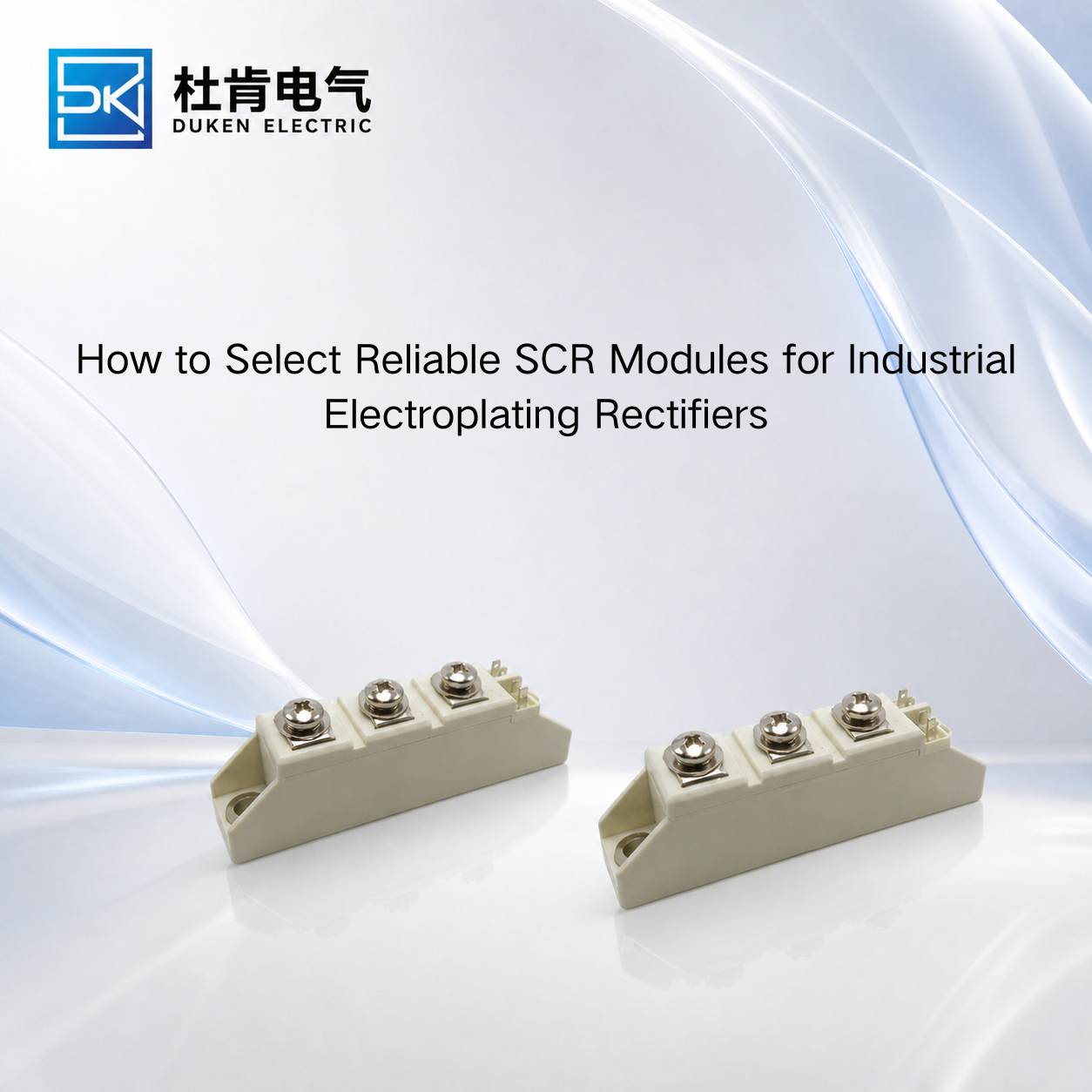
How to Select Reliable SCR Modules for Industrial Electroplating Rectifiers
Author: Selina
Selecting the right semiconductor is a critical decision when manufacturing industrial electroplating and electrolysis power supplies. A controlled rectifier for electroplating and electrolysis must deliver stable DC power while handling demanding current levels, voltage transients, and continuous thermal loading. For OEM manufacturers, purchasing managers, and electronic component distributors, the challenge is not simply finding an SCR with a suitable current rating. Electrical characteristics, internal circuit configuration, mechanical compatibility, quality consistency, and supplier reliability all influence the final equipment performance. This guide explains how to evaluate SCR modules, compare alternative technologies, qualify suppliers, and establish a dependable semiconductor procurement strategy.
1. Understanding SCR Module Requirements for Industrial Rectifiers
Before selecting a semiconductor module, engineers should identify the electrical architecture and operating conditions of the rectifier.
Different electrochemical applications may require substantially different power conversion configurations.
Identify the Rectifier Circuit Topology
Common industrial rectifier configurations include:
Single-phase controlled bridges.
Three-phase six-pulse controlled bridges.
Twelve-pulse controlled rectifiers.
Anti-parallel AC power controllers.
Multiple rectifier units connected in parallel.
Each topology requires a different semiconductor arrangement.
For example, a conventional three-phase six-pulse fully controlled bridge uses six individual SCRs, whereas an anti-parallel module contains two thyristors connected for bidirectional AC conduction.
These configurations are not interchangeable.
A supplier should understand the actual circuit before recommending a semiconductor product.
Define the Electrical Operating Conditions
The engineering team should prepare a component specification covering:
Requirement | Information Needed |
|---|---|
AC input voltage | Nominal and maximum voltage |
DC output voltage | Required operating range |
DC output current | Continuous and maximum current |
Surge conditions | Startup and fault current |
Blocking voltage | Required forward and reverse ratings |
Gate control | Trigger current and voltage |
Cooling | Natural, forced-air, or liquid |
Circuit frequency | AC supply frequency |
Installation | Mounting and terminal arrangement |
Environment | Ambient temperature and contamination |
These requirements provide a reliable basis for comparing different SCR manufacturers.
Understand the Difference Between Current Ratings
An SCR's average current rating and RMS current rating describe different electrical characteristics.
Average current relates to the average conduction capability under specified test conditions.
RMS current is particularly important for calculating semiconductor heating.
The actual current waveform must be considered when determining whether a device can operate safely in a particular rectifier.
A nominal 106A or 300A designation should never be treated as a universal continuous operating current.
2. Evaluating 106A Thyristor Modules and Their Technical Specifications
Compact thyristor modules can be useful in industrial power electronics because they integrate multiple semiconductor devices into one package.
However, module construction and internal topology must be verified before procurement.
Compact Seven-Pin Anti-Parallel Modules
A compact 7-pin anti-parallel 106A thyristor module for UPS systems contains two SCRs connected in opposite directions.
This configuration allows controlled conduction during both positive and negative AC half-cycles.
Typical applications may include:
AC power regulation.
Static switching.
Controlled bypass circuits.
Selected UPS power control functions.
Industrial resistance heating.
Bidirectional switching assemblies.
For electroplating equipment manufacturers, such a module may be relevant to auxiliary AC switching or control functions.
It should not automatically be considered a replacement for the individual SCRs in a main three-phase controlled rectifier bridge.
Understanding Surge Current and dv/dt Performance
Two specifications deserve particular attention in demanding power control applications.
Surge current capability
ITSM represents the maximum non-repetitive surge current under defined test conditions.
A module specified with a 2250A surge rating may offer useful short-duration overload capability, but engineers must check the waveform, pulse duration, initial junction temperature, and test conditions.
Critical dv/dt
The critical dv/dt rating indicates the voltage rise rate the device can withstand in its off-state under specified conditions.
A module specified at 1000V/µs may be suitable for circuits with corresponding transient requirements, subject to verification of the manufacturer's test conditions.
Neither specification should be interpreted independently of the complete protection design.
Important Datasheet Parameters
Parameter | Symbol | Why It Matters |
|---|---|---|
Repetitive forward blocking voltage | VDRM | Forward voltage withstand |
Repetitive reverse blocking voltage | VRRM | Reverse voltage withstand |
Average on-state current | IT(AV) | Current capability |
RMS on-state current | IT(RMS) | Thermal loading |
Surge current | ITSM | Short-duration overload |
Surge integral | I²t | Fuse coordination |
On-state voltage | VTM | Conduction losses |
Gate trigger current | IGT | Trigger circuit design |
Gate trigger voltage | VGT | Gate-drive compatibility |
Thermal resistance | RthJC | Cooling design |
Buyers should obtain the official datasheet and compare values under equivalent test conditions.
3. Mechanical Compatibility, Thermal Design and Sample Testing
Even when two SCR modules have similar electrical ratings, their physical construction may differ.
For OEM manufacturers, mechanical compatibility is especially important when designing standardized rectifier cabinets or replacing existing components.
Verify Package Dimensions
Request a mechanical drawing and confirm:
Overall package dimensions.
Mounting hole positions.
Terminal layout.
Pin identification.
Electrical isolation.
Mounting surface.
Installation clearance.
For a seven-pin module, terminal identification is particularly important.
The internal circuit diagram should be checked against the equipment wiring diagram before installation.
Evaluate Thermal Characteristics
The module's thermal resistance determines how effectively heat can be transferred from the semiconductor junction to the heat sink.
A simplified conduction-loss equation is:
For a suitable single-sided cooling arrangement:
The total thermal resistance includes the junction-to-case, case-to-heat-sink, and heat-sink-to-ambient sections.
Engineers should evaluate the cooling design under actual operating conditions.
A module with a suitable current rating may still be unsuitable if its thermal resistance is too high for the available heat sink.
Why Sample Qualification Matters
Before purchasing large quantities, OEM manufacturers should conduct sample testing.
A practical qualification process includes:
Test | Objective |
|---|---|
Visual inspection | Check package quality |
Dimensional inspection | Verify installation compatibility |
Electrical blocking test | Confirm voltage withstand |
Gate triggering test | Check control compatibility |
On-state voltage test | Evaluate conduction characteristics |
Thermal evaluation | Confirm heat dissipation |
Application testing | Validate circuit operation |
Testing should follow appropriate laboratory procedures and manufacturer specifications.
Sample approval should be recorded before mass production purchasing.
4. Comparing SCR Modules with Alternative Power Semiconductor Technologies
SCR modules are not suitable for every power conversion application.
OEM engineers should compare them with other technologies according to the required control method and electrical performance.
SCR vs IGBT vs MOSFET
Technology | Main Strength | Main Limitation |
|---|---|---|
SCR | High-power line-frequency control | Requires current zero or external commutation for turn-off |
IGBT | Flexible PWM switching | More complex gate control |
MOSFET | Fast switching | Voltage and current rating tradeoffs |
SiC MOSFET | High-frequency efficiency potential | Higher device cost in many applications |
Rectifier diode | Simple and robust rectification | No gate-controlled output regulation |
Choosing SCR Technology
SCR modules remain attractive for applications requiring:
AC power regulation.
High surge-current capability.
Established line-frequency conversion.
Simple controlled rectification.
Mature industrial maintenance procedures.
When IGBT or MOSFET Technology May Be Better
IGBT and MOSFET-based converters may be more appropriate when the application requires:
High-frequency switching.
Advanced power factor correction.
Fast dynamic response.
Specialized DC conversion.
More flexible input-current control.
For electroplating and electrolysis rectifiers, the final selection depends on DC output requirements, power level, process response, energy efficiency, and system cost.
5. Supplier Qualification and Long-Term Procurement Strategy
The semiconductor supplier has an important influence on equipment quality and production continuity.
For industrial OEM manufacturers, a dependable supplier should provide technical documentation, consistent product quality, and responsive communication.
Product Quality and Traceability
Purchasing teams should evaluate:
Manufacturing quality controls.
Product batch identification.
Electrical test procedures.
Inspection records.
Quality management certifications.
Material compliance documentation.
Product change notification.
ISO 9001 certification can provide additional information about a supplier's quality management system, but actual product inspection and technical verification remain necessary.
Technical Support and After-Sales Service
For 2250A-surge 1000V/µs dv/dt screw-mount 106A thyristor module for UPS systems applications, buyers may need assistance verifying surge characteristics, mounting arrangements, gate-drive requirements, and transient protection.
Technical support should be able to address practical engineering questions rather than simply provide a product catalogue.
Before placing an order, clarify:
Warranty period.
Failure analysis procedure.
Replacement policy.
Production lead time.
Minimum order quantity.
Sample availability.
Long-term supply arrangements.
Technical communication channels.
Managing Long-Term Semiconductor Availability
Industrial electrochemical equipment may remain in service for many years.
An effective procurement strategy should therefore include:
Approved semiconductor models.
Qualified alternative suppliers.
Product specification records.
Sample test reports.
Spare-parts inventory.
Batch traceability.
Supplier performance reviews.
A qualified second source can reduce supply-chain risk and improve purchasing flexibility.
Evaluating Total Cost of Ownership
The cheapest semiconductor is not necessarily the most economical choice.
A practical total-cost model is:
For equipment manufacturers, production interruptions and replacement engineering can create substantial indirect costs.
Consistent product quality, technical support, and reliable delivery should therefore be included in supplier evaluations.
FAQ
1. What should OEM manufacturers check before purchasing a thyristor module?
They should verify the internal circuit topology, voltage and current ratings, surge capability, gate characteristics, thermal resistance, package dimensions, and official datasheet.
2. Can a 106A anti-parallel thyristor module replace two individual SCRs?
Potentially, if the internal circuit, electrical ratings, gate characteristics, package, and cooling arrangement are compatible with the original circuit.
3. What does a 2250A surge-current rating mean?
It indicates a specified short-duration non-repetitive current withstand capability. The exact waveform, pulse duration, and initial temperature must be confirmed from the datasheet.
4. Why is dv/dt immunity important in industrial power control?
High voltage rise rates can cause unintended triggering in SCRs. Suitable device selection and external protection help reduce this risk.
5. How can buyers evaluate a reliable SCR supplier?
Review product documentation, batch traceability, sample test results, manufacturing quality controls, technical support, warranty conditions, and long-term supply capabilities.
Conclusion
Selecting reliable SCR modules for industrial electroplating and electrolysis equipment requires a complete evaluation of electrical characteristics, internal circuit configuration, mechanical compatibility, and thermal performance.
For OEM manufacturers, a 106A anti-parallel module may be appropriate for selected AC switching applications, while larger controlled rectifier systems require semiconductor devices specifically qualified for their power circuit architecture.
A structured procurement process involving datasheet verification, sample testing, supplier assessment, and long-term inventory planning helps reduce engineering risks and improve equipment reliability.
By working with technically capable semiconductor suppliers, rectifier manufacturers can establish a more dependable supply chain and develop power conversion equipment suited to demanding industrial electrochemical applications.
READ MORE:
OEM Procurement Guide: Selecting Certified 106A Thyristor Modules for Industrial Power Supplies
Surge Protection and dv/dt Control in Industrial Induction Heating Power Supplies
Thermal Management of Thyristor Modules in Industrial Induction Heating Equipment
SCR vs IGBT: Choosing the Right Power Semiconductors for Induction Heating Equipment
Phase-Controlled Power Supply Design for Industrial Induction Heating Systems
High-Power SCR Rectifier Design for Continuous Industrial Electrolysis Operations
Constant-Current Control in Industrial Electroplating Rectifiers: SCR Design and Performance
Six-Pulse vs Twelve-Pulse SCR Rectifiers for Industrial Electrolysis Power Supplies
Controlled Rectifier Front-End Design for Industrial Electroplating and Electrolysis Systems